
Have you ever watched a perfectly planned event start to unravel, not because of the catering or the venue, but because the seating was not ready in time? It happens more often than most people expect, and in nearly every case, it comes down to a handful of avoidable mistakes made during the hiring process.
At Time 2 Hire, we have worked with enough weddings and corporate functions to know exactly where things tend to go wrong. This blog walks you through the most common seating hire mistakes that disrupt event timelines, and more importantly, how to avoid them before they become your problem.
Leaving Your Seating Hire Too Late
The Early Bird Really Does Get the Better Chairs
There is a reason experienced event planners lock in their furniture hire months before the event date. Popular seating styles, think sleek cross-back chairs, elegant Tiffany chairs, and modern ghost chairs, get snapped up fast, particularly during peak wedding and events season in Perth. If you leave your booking too late, you are not just risking your first choice of furniture. You are risking your second and third choices as well.
Booking early gives you access to the full range of available stock, the colours and styles that actually suit your event, and the peace of mind that comes with knowing one major element of your day is already sorted. When you find seating for your Perth event well in advance, you are setting yourself up with options rather than scrambling to work with whatever happens to be left.
Late Bookings Create a Domino Effect on Your Planning
Here is something that does not get talked about enough. Your seating hire decision does not exist in isolation. It connects directly to a string of other planning decisions that cannot be finalised until you know exactly what furniture you are working with.
Your floor plan depends on the dimensions of your chosen tables and chairs. Your stylist needs to know what pieces they are decorating around. Your venue coordinator needs confirmed furniture quantities to sign off on your layout. When your seating hire is still up in the air three weeks before the event, all of those conversations get put on hold too, and suddenly you are not just behind on one thing. You are behind on everything at once.
Peak Season is Less Forgiving Than You Think
Spring and summer in Perth are prime times for weddings, corporate end of year functions, and outdoor celebrations. Hire companies across the city are operating at full capacity during these months, and stock availability tightens considerably from around September through to February.
If your event falls anywhere in that window, the timeline for locking in your seating hire needs to shift earlier than you might expect. Waiting until three or four months out during peak season can already put you in a difficult position. Six months or more is a far safer buffer, especially if your event is large or your furniture requirements are specific.
The Hidden Stress of Last-Minute Hire Decisions
Booking seating hire at the last minute does not just limit your options. It adds a layer of stress to your planning that bleeds into everything else. Instead of spending the final weeks before your event focused on the finer details, you are fielding phone calls trying to track down available stock, negotiating delivery logistics under pressure, and hoping the furniture that does turn up matches the rest of your setup closely enough to work.
That kind of stress is entirely avoidable. Locking in your seating hire early is one of the simplest things you can do to protect your own headspace during what is already a demanding planning process. The earlier you commit, the more confidently you can move forward with everything else.
Underestimating How Long Setup Actually Takes
Spoiler Alert: It Takes a Lot Longer Than You Think
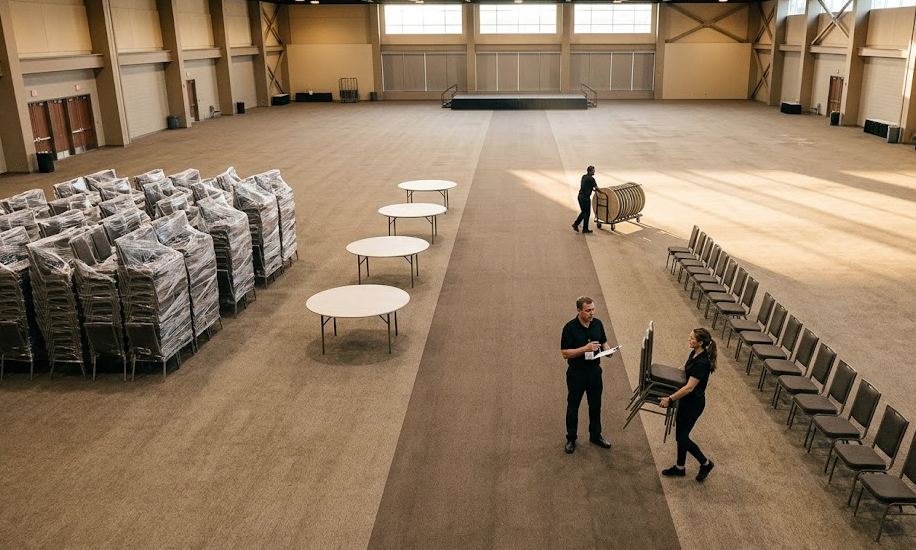
Setting up seating for an event sounds straightforward on paper. You put the chairs out, arrange the tables, and you are done. In reality, the process is far more involved than that, and planners who underestimate it almost always find themselves in a stressful race against the clock before their first guest walks through the door.
The time it takes to set up seating for weddings and functions depends on a long list of variables: the size of the venue, the number of seats being arranged, the complexity of the layout, the number of people involved in the setup, and whether the furniture needs to be configured in zones or shifted between spaces. Factor all of those together and what might feel like a one-hour job on paper can easily stretch to three or four hours in practice.
Your Layout Complexity Changes Everything
A simple row of chairs for a small ceremony and a full banquet layout for two hundred guests are worlds apart in terms of setup time, and everything in between sits on a sliding scale. The more intricate your layout, the longer it takes to get right.
Curved ceremony rows need careful measuring to look polished. Round dining tables need to be positioned with consistent spacing on all sides. Lounge clusters need to feel deliberately styled rather than randomly placed. Each of these takes time, patience, and a clear plan to execute well. Rushing any of them shows in the final result, and a setup that looks hasty or uneven is not the first impression you want your guests to have when they arrive.
Delivery Windows and Setup Time Are Not the Same Thing
One of the most common timing mix-ups we see is planners confusing furniture delivery time with setup completion time. These are two very different things, and treating them as the same leads to some genuinely stressful situations on event day.
Delivery covers getting the furniture off the truck and into the venue. Setup is the process of arranging every piece into its correct position, checking spacing, adjusting for any last-minute layout changes, and doing a final walkthrough to make sure everything looks exactly as planned. Depending on the size of the event, there can be a significant gap between when the last chair comes off the truck and when the room is actually ready for guests. Building that gap into your schedule deliberately, rather than discovering it on the day, is what keeps your timeline intact.
The Ripple Effect on Every Other Supplier
When the seating setup runs over time, it does not just affect the look of the room. It creates a ripple effect that touches every other supplier working in that space. Florists cannot finish centrepiece arrangements until tables are in their final positions. Caterers cannot set place settings until the dining layout is confirmed. Audio-visual teams may need access to areas that are still mid-setup. Photographers lose precious pre-event shooting time waiting for the room to come together.
Every supplier on your run sheet is working to their own tight schedule, and most of them are depending on the seating setup being completed before they can do their part. Giving the setup process the time it genuinely needs in your planning timeline is not just good practice for the look of your event. It is a courtesy to every other professional working alongside you to make the day a success.
Ordering the Wrong Quantity of Seats
Too Few Seats is a Crisis, Too Many is a Headache
Getting your seating quantity wrong is one of those mistakes that feels minor during the planning stage and enormous on the day. Order too few seats and you have guests standing awkwardly at the edges of the room, scrambling to find somewhere to sit while the event is already underway. Order too many and you end up with clusters of empty chairs cluttering the space, disrupting your carefully planned layout and making the room feel oddly sparse despite being full of people.
Neither scenario is a good look, and both are far more common than they should be. Working with quality seating hire services from the start means having someone in your corner who can help you work through your numbers accurately, rather than leaving it to guesswork and a rough headcount scribbled on a notepad three weeks before the event.
RSVPs Will Catch You Off Guard If You Let Them
Guest lists are living, breathing things right up until the week before your event. People confirm late, cancel unexpectedly, add a plus one without mentioning it, or simply do not respond at all until you chase them down. Relying on your RSVP count as a fixed number when placing your seating hire order is a gamble that rarely pays off.
The smarter approach is to treat your RSVP count as a starting point rather than a final figure. Build a small buffer into your order, somewhere between five and ten percent above your confirmed guest count, to absorb the last-minute additions that almost every event experiences. That buffer costs very little in the context of your overall hire spend, and it saves you the very real stress of hunting down additional matching chairs two days before your event when stock availability is at its tightest.
When Quantities Change, Consistency Becomes a Problem
Last-minute seating additions are stressful enough on their own. What makes them genuinely problematic is when the extra chairs or tables you manage to source do not match the furniture you originally hired. Suddenly, you have a mix of styles, finishes, or heights sitting side by side in the same space, and no amount of styling can fully disguise the inconsistency.
This is a situation that catches a lot of planners off guard because it feels like a small detail in the moment of crisis. When you are focused on finding any available chair two days out from your event, matching the timber finish feels like a secondary concern. On the day though, mismatched furniture stands out in photos, draws comments from guests, and undermines the cohesive look you spent months pulling together. Getting your quantities right from the start is the simplest way to make sure it never becomes an issue.
Building a Buffer is Cheaper Than You Think
A lot of planners hesitate to order above their confirmed guest count because they are already watching their budget closely. It is a completely understandable instinct, but it is worth putting the cost into perspective. Hiring a handful of extra chairs as a buffer adds a modest amount to your overall spend. Arranging an emergency top-up order close to the event, if stock is even available, often costs significantly more per unit and may involve additional delivery fees on top.
Thinking about your seating quantity buffer as a form of insurance rather than an unnecessary expense shifts the calculation entirely. You are not paying for chairs you might not need. You are paying for the certainty that your event will not be derailed by a guest list that moves in the final stretch, as they almost always do.
Ignoring Venue Restrictions and Access Windows
Your Venue Has Rules, and They Will Not Bend for You
Every venue has its own set of rules around when suppliers can access the space, and seating hire is no exception. Some venues allow setup from early morning. Others restrict access to a narrow two-hour window before the event begins. Assuming you can walk in whenever suits you is a mistake that throws your entire setup schedule into chaos before it even begins.
Understanding what seating you need for an event is only half the picture. Knowing exactly when and how that furniture can be delivered and set up within your specific venue is just as critical to keeping your timeline on track.
When Delivery Times Clash With Access Windows
A seating hire delivery that arrives outside your venue’s access window does not just cause a minor inconvenience. It triggers a domino effect across every supplier working that day. Florists, caterers, and audiovisual teams all lose setup time while everyone waits for the furniture to be cleared and positioned first.
Communicating your venue’s access details to your hire company well in advance eliminates this risk entirely. Share the exact window, any loading dock requirements, and whether a venue coordinator needs to be present during delivery. The more clearly this is communicated upfront, the smoother the handover on the day.
Talk to Everyone Early and Often
The venues and suppliers who run the smoothest events share one common habit: they over-communicate during the planning stage. Confirm access windows in writing, loop in your hire company as early as possible, and check in again as the event date approaches.
A quick conversation weeks out from your event takes minutes. Resolving a delivery clash on the morning of your event takes much, much longer.
Small Mistakes, Big Consequences: Get Your Seating Hire Right From the Start
Have you spotted any of these mistakes in your own event planning process? If so, you are certainly not alone. The good news is that every single one of them is avoidable with a little foresight, some early conversations, and a hire partner who knows what they are doing.
At Time 2 Hire, we have helped countless clients in Perth navigate the seating hire process without the stress, the last-minute scrambles, or the timeline blowouts. From locking in the right furniture early to making sure delivery and setup run like clockwork, we are here to make the whole process easier. Contact us today, and let’s get your next event sorted the right way.